
Why Arsenal Struggle to Score in Open Play...
- Mo Fathalli

- Feb 22
- 6 min read

Arsenal and Mikel Arteta have turned what looked like a simple run to their first league title in 23 years into a potential tight two horse race with Manchester City, after dropping 11 points since the start of 2026.
The Gunners have proven to be a very strong side when building from the back and sustaining pressure. They are also extremely difficult to break down. On top of that, they have almost “hacked” set pieces, becoming the most dangerous team in the world when it comes to dead ball situations.
Despite all of this, there is still one issue holding Arteta and his side back. It is affecting their ability to create from open play, and that is the lack of central infiltration.
Elite at everything, except in what matters most?
In their two wins, two draws and one loss against Leeds, Sunderland, Brentford, Wolverhampton and Manchester United, Arsenal created 42 goal scoring opportunities and scored 12 goals. Not bad over a five game run, right?
When you look closer at how these chances and goals came, you start to see where the real issue lies. 18 of those opportunities, and seven of the goals, came from their well known wide play. Arsenal’s go to method against different defensive blocks is to work the wide triangles, with the aim of isolating their wingers or creating 3v3 situations. To be fair, this approach has been devastating.
The wingers look to create from wide areas, either by beating their man or delivering crosses into the box. The fullbacks constantly make supporting runs, both on the outside and inside of the block, either to receive the ball or to create more space for the wingers. At the same time, the midfielders offer options in the half spaces, whether to cross or to slip runners through inside.

The second method that led to most of Arsenal’s chances was, unsurprisingly, free kicks. Across these five games, they generated 12 goal scoring opportunities from set plays and scored two goals, Darlow’s own goal against Leeds and Merino’s equaliser against Manchester United.
In third place come transitions, which resulted in six opportunities and two goals. That brings the total to 37 chances and goals combined, leaving just five chances and one goal from their least used method of chance creation: central infiltration.
Now before we go further, what does central infiltration actually mean? It is simple. This is not about progressing the ball from deep areas but more about the team’s intentions when they are camped in the final third and sustaining attacks. Do they look to play passes into tight central spaces, especially into zone 14 (around the D area)? Do the players try to combine through quick one touch passes and flicks to catch their markers off guard and break into the back line?
Maybe this Bodo Glimt goal against Inter in the Champions League gives a clear example of what central infiltration really looks like.
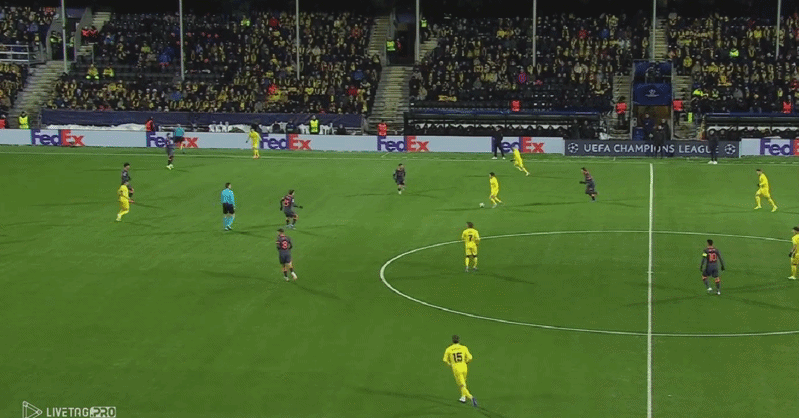
Going back to the Gunners, as mentioned earlier, only five of their 42 goal scoring opportunities came from central infiltration, and even that might be generous. One of those chances came against Brentford in the dying minutes, when Timber found himself through on goal after a pass from deep by Gyokeres. The whole sequence originated from a deep throw in. Another came from Rice carrying the ball all the way from midfield into zone 14 by himself.
The other three came in the same game against Leeds, with one of them leading to Gabriel Jesus’ fourth goal of the match.

So technically speaking, most of these chances that were labeled as central infiltration did not really come from a clear intention to attack through the centre.
How is this affecting Arsenal’s open play creativity?
In most of their games, Arsenal dominate possession and sustain pressure for long spells. Because of that, they do not get many chances to hurt teams in transition. As for free kicks, even though Arsenal are without doubt the best team in the world in this area, both in terms of preparation and the profiles they have, set pieces simply cannot be a sustainable source of chances. In 27 games, Arsenal have scored 16 goals from set pieces this season, but only two of those came in the last five games used as our sample. So while it has not completely dried up, the rate has dropped by about a third compared to their season average.
That leaves their most consistent and dangerous method, which is wide play and triangles. But like any approach in football, it can be limited by different factors. Injuries, players being out of form, or teams preparing specifically to stop it can all reduce its impact.
For example, in their 0 0 draw against Chelsea at Stamford Bridge, the Blues managed to limit Arsenal’s wide threat even after going down to 10 men when Caicedo was sent off in the 38th minute. Their players were disciplined in knowing when to press and when to track runs in behind. Arteta’s substitutions, bringing on Madueke and Odegaard for Martinelli and Zubimendi, did increase the threat and led to the equaliser, with Merino finishing from Saka’s cross. Still, most Arsenal supporters would agree that the game felt like two points lost rather than one gained.

This is where Arsenal start to struggle. When their most dangerous weapon is dealt with, when the set piece return begins to drop and transitions are not there, why do they not threaten more through the centre?
Is it about personnel? Or is it something deeper?
Some would argue that the players Arteta has are not suited to this kind of chance creation, one that depends on quick combinations through the middle. That might be partly true, but it does not tell the full story. Players like Saka, Gabriel Jesus, Leandro Trossard, the newly signed Eze and even the often criticised Martin Odegaard have the technical quality to operate in tight spaces. So what is really stopping them?
Beyond selection and player profiles, the intention to attack through the centre is simply rare when watching Arsenal. In many moments against Brentford, the Gunners had the chance to threaten centrally. Instead, there was a clear focus on keeping a strong rest defence structure rather than using the available space. When central lanes opened, the ball was recycled out wide to restart their wide patterns, all while central areas were left empty in order to overload the back line and attack crosses. The below examples illustrate the mentioned above.


The 4-0 win over Wigan right after the Brentford game saw Mikel Arteta experiment with Saka in a more central role. The result and performance looked like signs of change. But even though Saka started in a similar position in the 2-2 draw against Wolves, it became clear that changing positions, structures or formations does not automatically change a team’s intentions.
On more than one occasion, it felt like the players were almost programmed to avoid central infiltration. In this moment for example, Rice makes a run that could have opened a clear path towards Saka. But Martinelli does not allow the situation to develop. Instead, he chooses to cross into a box filled with a striker who is not dominant in the air, a winger who ends up contesting the header, and a centre back playing at right back.
In another sequence, you can see how Arsenal’s players looked like they were not used to targeting and attacking central areas to combine. The diagonal pass into the middle was one of the rare moments they tried it, and even then Saka’s movement could have been sharper to attack the midfielder’s blind side and arrive into space. None of that happened, and the move once again ended with a cross.

It’s in Arteta’s hands
There is nothing forbidden with choosing to be a risk averse side. Perhaps as neutral, we dislike watching sides that are being safe just because we want entertainment. Still, we cannot deny that Arsenal are in a strong position to have a special season thanks to this approach. However, there will always be margins for things to improve.
It is clear that Arsenal’s players are not coached to attack with the intention of infiltrating through the centre. Central zones are often left empty, players do not target options when they appear, and the awareness to play quick diagonals, combinations and flicks is almost non-existent. At this stage of the season, it would not make sense for a manager to abandon what brought him here and start building something completely new. So there might be two solutions that can go together for the remainder of the campaign.
The first is selection. Starting players like Trossard and Eze against lesser teams could help, given their technical quality. Myles Lewis-Skelly is another player who proved to have influence in central areas, with his performance against Atletico Madrid as proof. But more importantly, Arteta needs to encourage his players to take more risks, especially when their other methods are being dealt with. A slight tweak in intentions, a nudge to the players to express themselves more could be all that Arsenal need. Eze in particular could be the catalyst if platformed correctly. The majority of the 27-year-old’s contribution this season came from him showing his creativity from within central areas.
Maybe it’s time the shackles went off, otherwise, the lack of variety will make the Gunners predictable, and avoiding risk will become the biggest risk of all.


Comments