
LIAM ROSENIOR'S CHELSEA: STYLE, STRUCTURE & PRINCIPLES
- Mik Van Well

- Jan 22
- 6 min read
Updated: Jan 22

Liam Rosenior’s Chelsea tenure began with an FA Cup win over Charlton Athletic. Results against Arsenal and Brentford showed clear signs of his tactical identity - one he previously used at Strasbourg.
Rosenior wants his teams to play with intensity, bravery, and control, both in and out of possession. However, managing a top club like Chelsea brings extra pressure, and some principles are still being adapted to suit the players available.
Build-Up Principles & Structure
Build-Up Principles

Rosenior strongly prefers short build-up play from the back.
Chelsea will:
Build short when they have a numerical advantage in defence
Use quick combinations to play through pressure
Attract man-to-man presses to create space elsewhere
Only when opponents remove their spare defender does Chelsea go more direct and vertical.
Build-Up Structure

Although Chelsea lined up in a 4-2-3-1, their in-possession shape often looked very different.
During build-up:
Chelsea formed a 3-2-4-1
A box midfield was created
This allowed control through central overloads
This structure is common in possession-dominant teams and helps progress the ball centrally.
The Goalkeeper's Role

One of Rosenior’s most distinctive ideas is the goalkeeper joining the defensive line.
Instead of staying behind a back three:
The goalkeeper steps into the back line
Chelsea temporarily form a “back four” without a sweeper behind
This worked well for Rosenior at Strasbourg, but at Chelsea it created problems.
Sánchez vs Penders: Why the Role Matters
At Strasbourg, this role suited Mike Penders perfectly. At Chelsea, Robert Sánchez has struggled to replicate it.

Mike Penders (Strasbourg)
Comfortable receiving under pressure
Strong short-passing accuracy
Calm decision-making between the lines
Happy to attract pressure before releasing a teammate
Penders’ skill set allowed Rosenior’s build-up to function with controlled risk.
Robert Sánchez (Chelsea)
Less comfortable playing between the lines
Slower decision-making under pressure
Lower short-passing accuracy
Struggled when opponents refused to press
When It Went Wrong in Build-Up (Sánchez)
Chelsea’s build-up issues were most visible when Robert Sánchez was not pressed aggressively and had time on the ball.
Example 1: Press Resistance Without Pressure
In this moment:
Sánchez plays into Fofana at the edge of the box
Fofana is already signaling to play wide to Fernández
Fernández is positioned in a less dangerous, wider zone
Instead of playing into the safer option early, the delayed decision invites pressure, placing Fofana under stress in a risky area.
Result: Chelsea lose control of the build-up at the edge of their own box.
Example 2: Poor Decision-Making Without Pressure
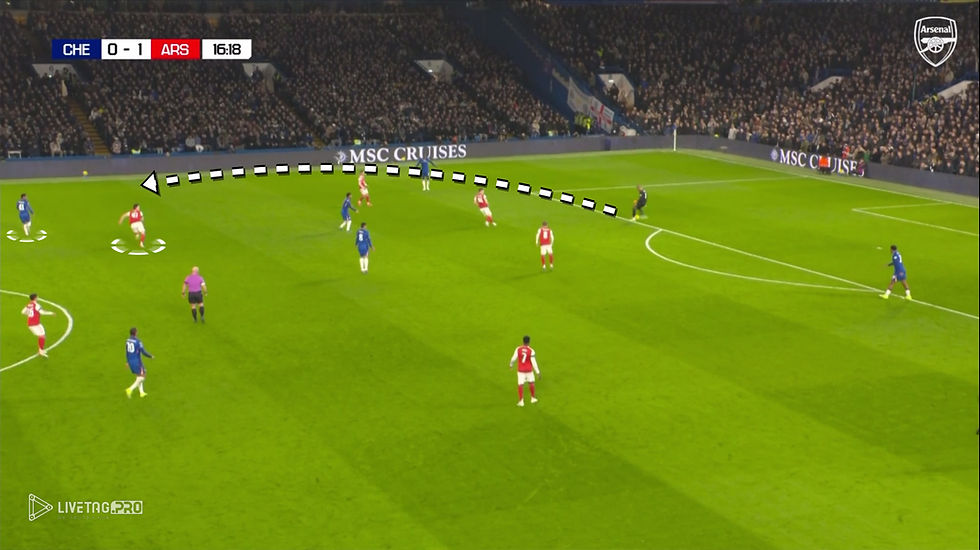
In a separate situation:
Sánchez is not under immediate pressure
He chooses a chipped pass into Estevão
Estevão is moving wide from the right half-space
Declan Rice anticipates the pass early
The pass is obvious, easy to read, and immediately puts Chelsea at risk.
Result: Arsenal regain possession and launch a dangerous attack.
Flexibility in Build-Up

Rosenior showed flexibility without abandoning his core structure.
Against Arsenal:
Cucurella moved into the left half-space
Hato moved to deep left back (Cucurella's space)
Same structure, different movements
This shows Rosenior prioritises structure over fixed positions.
Adapting Against Brentford

Brentford pressed man-to-man early, which changed Chelsea’s approach.
Adjustments included:
Both full-backs pushing higher
Sánchez allowed to play more direct
João Pedro dropping deeper to create space
This created:
A central box with midfielders and striker
Space for wide runners to attack directly
Settled Possession Shape

Once Chelsea established control:
The goalkeeper returned to a normal sweeper role
The team settled back into a 3-2-4-1
The box midfield remained central to control
After missing the Arsenal game through injury, Reece James returned to the starting XI and was used in a new way.
Instead of staying wide:
James inverted into midfield
He formed a double pivot with Caicedo
Chelsea could still build into a back three behind them
This small change solved multiple problems at once.
James’ movement allowed:
Enzo Fernández to move higher
Fernández to operate in the left half-space
Chelsea to create a box midfield
This is the zone where Fernández is most comfortable and effective, both on and off the ball.
Transitions

Rosenior’s approach in transition mirrors his build-up principles.
Chelsea are:
Quick and direct when space is available
Patient and controlled when it isn’t
If the opponent’s rest defence is well organised:
Chelsea slow the game down
Revert to short combinations
Maintain a clear positional structure
Man to Man Pressing Out of Possession
Defensively, Chelsea usually lined up in a 4-4-2.
Key features:
Attacking midfielder joins the striker
Occasional shift to a 4-1-4-1
Aggressive man-to-man pressing triggers
Man-to-Man Pressing Risks
Rosenior prioritises marking players over zones.
This caused problems:
Centre-backs followed midfielders deep
Defensive line became stretched
One lost duel could break the entire structure

In this example: This 2v1 situation occurred because Enzo Fernández lost his direct opponent.
While Fernández has outstanding qualities on the ball:
He lacks the top-end speed to recover over long distances
During man-to-man pressing, one athletic mismatch is enough to disrupt the strategy.

Even when every player successfully tracks their direct opponent, one lost duel can still disrupt the entire system.
In this example:
Fofana loses his individual duel with Ødegaard (arguably a foul)
The defensive structure immediately breaks
Ødegaard is able to carry the ball freely into the final third
Low Block Issues
Even in a low block:
Players continued to follow opponents tightly
Passing lanes towards goal were sometimes left open
Midfielders were dragged into large defensive spaces
This highlighted the risk of extreme man-marking at elite level.

In this example:
Fofana continues to follow Ødegaard deep into Chelsea’s defensive third
This movement opens the passing lane towards goal
As a result:
Enzo Fernández is left covering large spaces
He is responsible for tracking multiple forward runs
This again highlights Rosenior’s preference for marking players over protecting zones, even when defending deep.
Confidence in the Defensive Structure
Despite the defensive issues shown against Arsenal, Rosenior remained confident in his principles in the following match.
The return of Moisés Caicedo helped justify that confidence.
Compared to Fernández, Caicedo offers:
Greater defensive awareness
Higher athletic output
Better ability to cover large spaces
As a result, the defensive structure remained unchanged against Brentford.
Defensive Approach vs Brentford

1. High Block Structure
Chelsea began by defending in a high 4-4-2 block.
Front two set the pressing line
Midfield stayed compact behind
Pressing triggers were clearly defined

2. Man-to-Man Pressing
From the high block, Chelsea committed to an aggressive man-to-man press.
Centre backs followed opponents into midfield
Individual responsibilities were strict
Chalobah is highlighted stepping out to engage his direct opponent
Late-Game Defensive Adaptation (Final 20 Minutes vs Brentford)

During the final twenty minutes against Brentford, Liam Rosenior showed a clear willingness to adapt Chelsea’s defensive structure in response to game state and personnel.
This adjustment followed Cole Palmer moving to the right wing. Rather than demanding deep recovery runs from his most influential attacker, Rosenior subtly altered the team’s pressing responsibilities around him.
The collective pressing shape was adjusted to protect the right side
Palmer was relieved of heavy defensive duties
Defensive stability was maintained without compromising attacking threat
This was a situational tweak, specific to protecting a late lead, and separate from Chelsea’s broader structural principles discussed earlier - particularly the centre-backs stepping out during earlier phases of the match.
Pressing Shape & Immediate Counter-Pressing

In Rosenior’s pressing model, structure and aggression work together.
Centre backs remain within the defensive line
The back line shifts across to the ball side (right flank in this example)
Compactness is prioritised over individual chasing
After losing possession:
Players closest to the ball apply immediate pressure
The opponent’s time on the ball is reduced
Teammates further away recover their positions
This combined approach allows Chelsea to:
Regain control quickly
Prevent counter-attacks
Maintain territorial dominance

An additional benefit of Rosenior’s counter-pressing approach is seen when Chelsea lose the ball high up the pitch.
In this example:
Fernández loses possession at the edge of the opposition box
Immediate pressure is applied by Fernández and Garnacho
The opponent has no time to settle or clear
As a result:
Chelsea quickly regain the initiative
The ball falls to João Pedro
A shooting opportunity is created
Key Takeaway
Liam Rosenior has a clear and brave tactical identity.
Strong belief in structure and principles
Willingness to adapt roles, not ideas
High-risk approach, especially in build-up and pressing
Early signs suggest mixed results are likely. The big question is whether Rosenior will be allowed the time to refine his ideas - or whether Premier League pressure forces him to compromise.


Comments