
CARRICK TRUMPS ARTETA IN FIVE-GOAL EMIRATES THRILLER: FULL MATCH ANALYSIS
- Mo Fathalli

- Jan 26
- 5 min read

Michael Carrick led Manchester United to their second consecutive league win in just two games in charge. Both victories came against the two main title contenders, Manchester City and Arsenal, with the latter suffering their first home defeat of the season at the Emirates thanks to goals from Mbeumo, Dorgu, and Cunha.
However, the results alone are not the only reason the United fanbase is buzzing. It is the performances and the manner in which these games were won, once again highlighting what the “United DNA” looks like on a big stage, particularly away from home at the Emirates.
Lineups:

Carrick followed the “never change a winning side” rule:
Goalkeeper: Lammens
Defenders: Dalot, Maguire, Martínez, Shaw
Double pivot: Mainoo and Casemiro
Attacking midfielder: Bruno Fernandes
Attack: Mbeumo as the striker, with Diallo and Dorgu on the wings
Arteta went with a different frontline compared to the Nottingham Forest draw:
Goalkeeper: Raya
Defenders: Timber, Saliba, Gabriel, Hincapie
Midfield Three: Odegaard, Zubimendi, Rice
Attack: Saka, Jesus, Trossard.
Reliable Pressure, Compact Block.
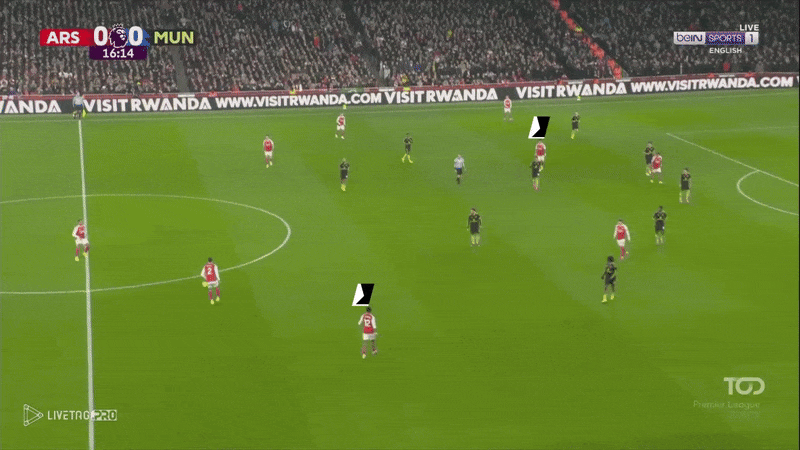
Manchester United mainly defended in a 4-4-2 shape and, contrary to what many may have expected, Carrick’s side did not travel to the Emirates to simply park the bus. Instead, United followed a hybrid pressing scheme.
Mbeumo and Bruno operated as the two forwards, applying pressure on Arsenal’s centre-backs.
Amad and Dorgu were positioned to jump onto the full-backs when required.
Mainoo and Casemiro alternated between protecting space and covering their direct opponents.
The back line maintained a +1, with Maguire and Martínez often doubling up on Jesus.
The idea behind this approach was to prevent Arsenal from sustaining prolonged pressure inside United’s defensive third. By applying controlled but reliable pressure on the ball, United were able to force Arsenal backwards and into wider areas, limiting their ability to pin United deep and maintain pressure higher up the pitch.

However, this does not mean Arsenal struggled to retain possession, circulate the ball, or progress play, even when they were forced backwards. Every tactical approach comes with its drawbacks, and with a hybrid pressing scheme, the main risk is allowing the opposition access to a free man. Arsenal were able to exploit this at times, particularly when Manchester United were transitioning from their low block to defending higher up the pitch.
Arsenal achieved this through the following mechanisms:
Rotations: Ex; Zubimendi dropping to left-back, Hincapié pushing higher into the left-wing role, and Trossard moving inside to create confusion around United players’ responsibilities, while also pinning the double pivot and full-backs.
Centre-backs circulating the ball and splitting either side of the goalkeeper, increasing the pressing distances for Mbeumo and Bruno before either finding the free man or carrying the ball forward themselves.

From there, Arsenal looked to activate their wide dynamics. On the right, Timber was pushed into the half-space, where he could combine with Saka, Ødegaard, and Jesus. On the left, Hincapié and Trossard worked higher and wider, looking to deliver crosses into the box.
Despite Manchester United maintaining vertical compactness for large spells and matching Arsenal in wide areas to limit their threat, the Gunners still managed to score from a similar wide scenario.
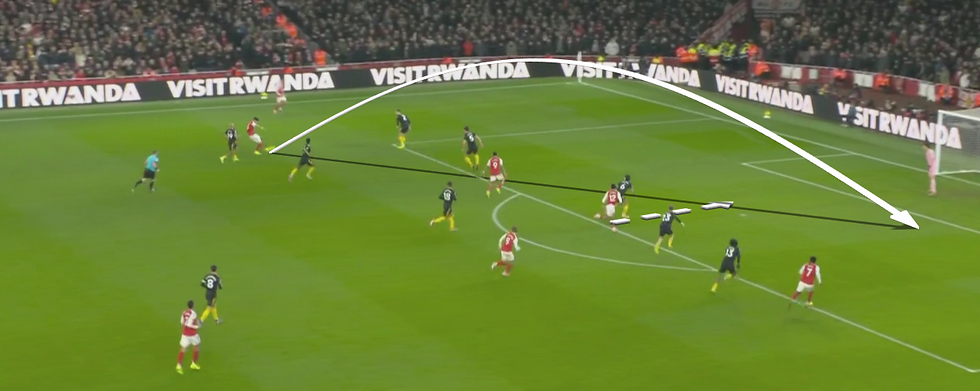
That said, the Red Devils conceded just 0.39 xG from open play, a reflection of their ability to maintain numerical equality in wide areas, defend 1v1 situations effectively, and limit Arsenal’s threat inside the box.
Manchester United were eventually rewarded for their proactive defensive approach. After initially losing the ball from a long goal-kick, they managed to turn Arsenal’s build-up sequence into an equaliser just eight minutes after the Gunners had opened the scoring.
Midfielders blocking central space.
Wide players ready to jump.
Forwards applying pressure.
Forcing play backwards and capitalising on mistakes.
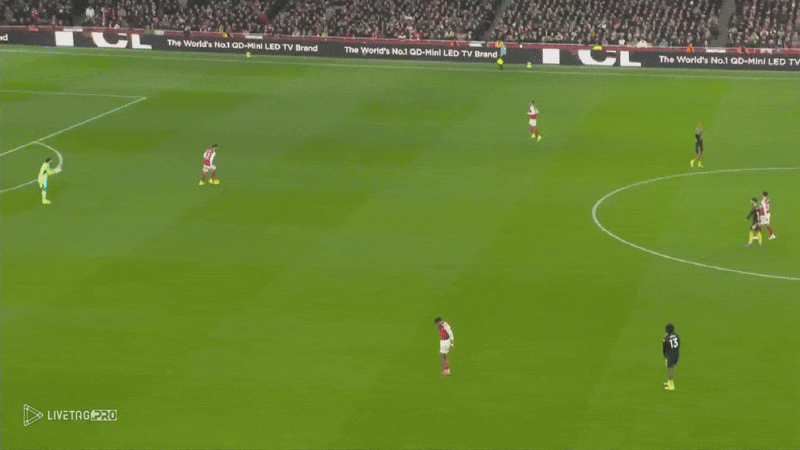
It is also worth noting that the Red Devils remained committed to this game plan across different game states. After taking the lead, conceding the equaliser, and then going ahead again through Cunha’s third, Michael Carrick’s side continued to apply pressure when required, doing so in a measured and controlled manner. This denied Arsenal the opportunity to camp in United’s defensive third and sustain prolonged pressure.


UNITED'S DNA
Against Manchester City, Michael Carrick emphasised the idea of inviting pressure through rondo-like situations. This meant clustering players in specific areas of the pitch to form triangles and diamonds, circulating the ball with one- and two-touch play to draw opposition players in and, in turn, create space elsewhere. However in this game, and for large parts of the first half, Manchester United struggled to execute this, mainly due to Arsenal’s defensive approach:
Applying intense pressure through a 4-4-2 structure to clog the center and force play wide.
Ødegaard pressing the ball carrier while Jesus locked play into wide areas.
Full-backs and midfielders aggressively joining the ball side to deny United overloads, rondos scenarios and to force turnovers.
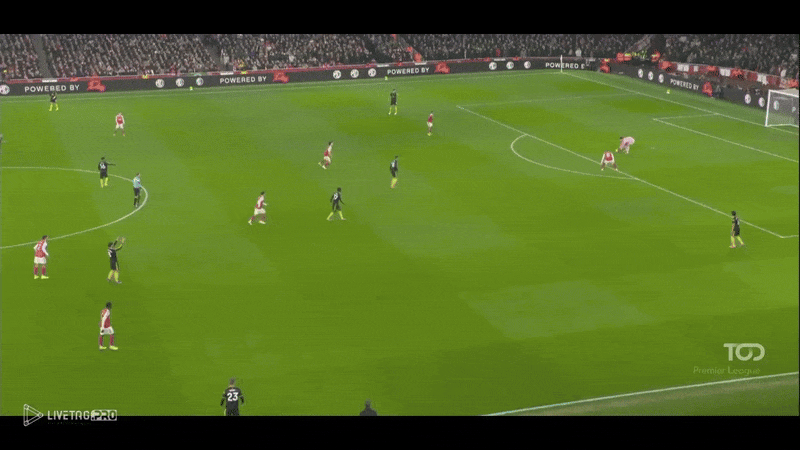
United’s in-possession performance did improve as the game went on. Still, aside from Mbeumo’s goal, they were unable to register a shot on target in the 1st half, largely due to their inability to progress the ball consistently into Arsenal’s half.
The second period, however, told a different story. With Arsenal dropping both their intensity and block deeper into the second half, Manchester United were not only able to sustain possession for longer spells, but also placed greater emphasis on playing in triangles, changing tempo, and threatening by playing through, around, and over the block. In the fast-forwarded sequence below, we can see:
Amad, Mbeumo, and Dalot combining in triangles, keeping the ball higher up the pitch and threatening to play around the block.
Martínez and Maguire controlling the tempo staying on the ball, playing sideways, and then increasing the pace through sudden carries, while also threatening to play over (Maguire going long) and through (Martínez attempting to find Bruno).
United losing the ball on three occasions but still managing to regain possession, both due to their counter-pressing structure and Arsenal’s limited transition threat.
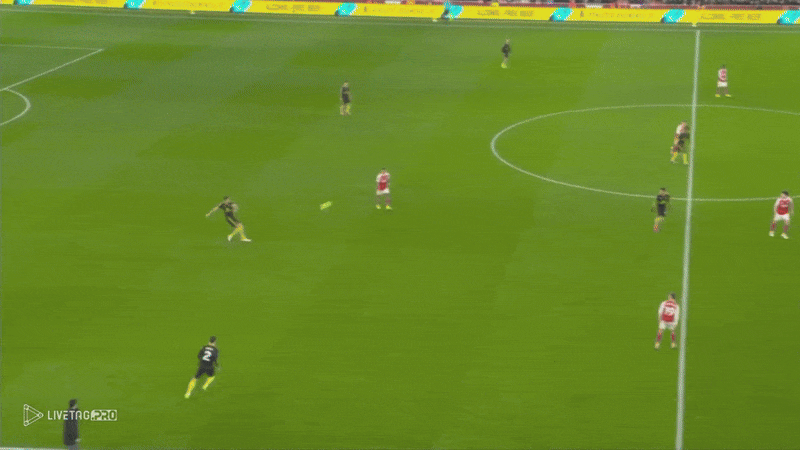
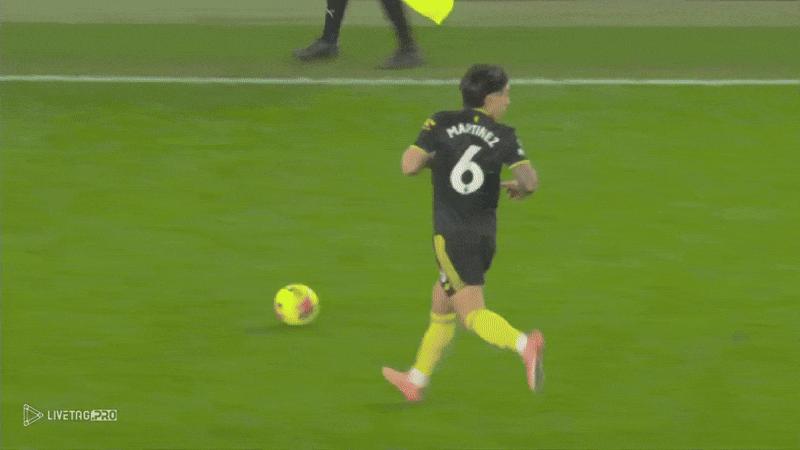
Before Martínez got back on the ball, United spent close to two minutes in sustained possession executing the patterns described above. Just 33 seconds later, Dorgu found a way to score United’s second goal.
Martínez staying on the ball, inviting pressure from Ødegaard.
Maguire increasing the tempo with a sudden carry.
Mainoo and Bruno on the move, manipulating their markers and creating space for others.
After circulating the ball patiently, Martínez once again changed the tempo with a through pass to Dorgu. From there, combination play followed before the goal.
Arsenal pulled themselves back into the game with a goal from a set piece, but Manchester United’s “DNA” which is their flexibility to threaten in multiple ways, was once again on display. This time, United went over the block first before setting the conditions for quick touch-and-move combinations.
Šeško acting as the target man.
A four-man second-ball “net” positioned underneath.
Two outside-of-the-foot passes from Bruno and Mainoo, both played with minimal touches.

These two performances under Michael Carrick felt like a reminder of what Manchester United can look like when there is clarity in both ideas and execution. The Red Devils showed flexibility across game states, the ability to threaten in multiple ways, and, most importantly, an understanding of when to control the game and when to accelerate it. Whether through structured pressing, sustained possession, or direct play over the block, United consistently found solutions to different problems posed by Arsenal.
Questions on how United will deal with low blocks and tight defenses are still legitimate. Two wins against the two title contenders is no small feat, but it also cannot give a clear idea on the ceiling of Michael Carrick’s principles and methods. And so, while the fanbase is rightfully buzzing, there is still time before anyone can draw any definitive conclusions. The signs are bright. If built upon, these foundations could finally put Manchester United on the right track to find their identity again.


Comments