
Off-ball Movement is Your 12th Player
- Mo Fathalli

- Mar 19
- 6 min read

Whether we like it or not, modern football is increasingly shaped by man-to-man defensive schemes. Whether applied across the entire pitch or within specific zones, teams are more inclined to adopt man-oriented approaches to deny the free man and force their opponents to go long and deny them controlled possession.
As a result, the 11v11 game has gradually turned into a series of individual duels across the pitch. Naturally, the attacking solutions have evolved. Rotations, third-man combinations, and especially strong ball carriers and dribblers can act as kryptonite against man marking.
But there is another layer that is receiving far less attention. Off-ball movement.
Why Off-Ball Movement Matters
As mentioned earlier, the modern game is increasingly defined by 1v1 duels across the pitch. But those duels do not begin at the moment of reception, they start before the ball even arrives.
Off-ball movement allows a player to shape the conditions of that duel in advance. By adjusting positioning, timing, and angles, a player can influence his direct marker, receive with greater separation, and more.
On a collective level, the impact is even greater. A single movement can drag a marker, distort a defensive line, or open a passing lane elsewhere. In that sense, movement without the ball becomes an active manipulation of the opponent’s structure.
If there’s no space behind, create it yourself.
Let’s start with double movement. The clue is in the name. It’s two actions within one move. You move one way to influence your marker, then the opposite way to attack or arrive in the space you just created. Perhaps the following sequence illustrates it best.
2024, Allianz Arena. Champions League semi-final, first leg between Bayern Munich and Real Madrid, ending in a 2–2 draw. Vinícius Jr opened the scoring in the 24th minute, and while the world kept talking about Toni Kroos’ magical through ball, it was the Brazilian’s off-ball work that created the goal from nothing.
Here, three crucial components were visible in Vini’s play: awareness, timing, and execution.
He maintains an open body orientation, allowing him to scan both the ball and Bayern’s defensive line. He doesn’t telegraph his intention of performing a double movement but stays relaxed and only performs it at the last second

The second Kroos receives the ball, Vinícius checks Laimer’s positioning, recognizes he was pinned by Madrid’s wide player and drops just enough to pull Kim higher up the pitch. With no pressure on Kroos and with Kim taking the bait, Vini knows he can immediately attack the space he has created for himself (that and Kroos giving a subtle hint with his hand.)

You Don’t need the ball to beat your marker.
Fast forward to 2026. During the clash between Olympique Marseille and Lyon, 18-year-old Remi Himbert opened his Ligue 1 goal tally while showing exactly how to manipulate an opponent before even receiving the ball.
The second Remi recognizes that his teammate has beaten his man and has the space to progress, he immediately checks his direct marker. From there, he subtly adjusts his footwork, slightly changing direction and beginning to influence the defender in order to commit him.
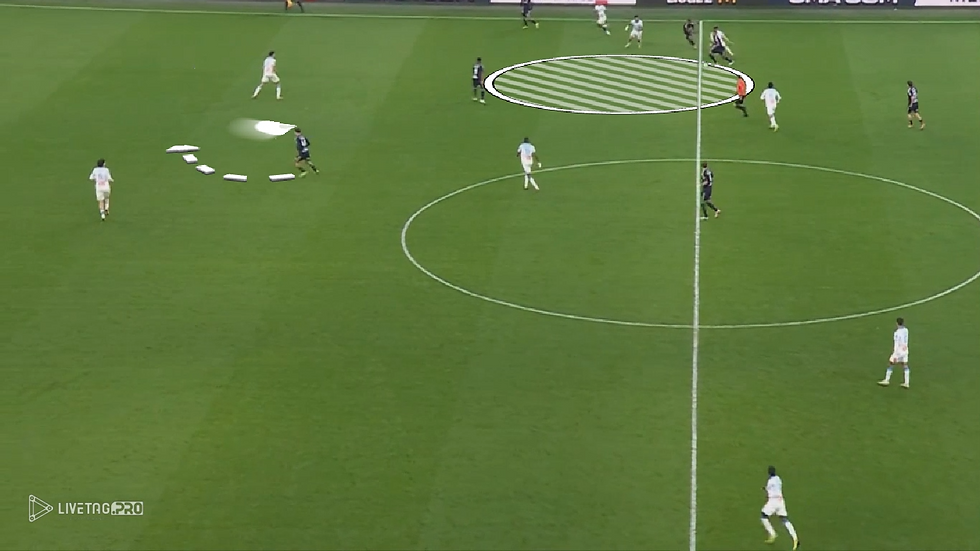
As Endrick was about to receive, Remi takes another glance at his marker. He knows the defender is now committed and this time he aggressively changes direction into the open space.

Not only does this create further separation for Remi to receive, but it also disrupts the defender’s footwork and forces him onto the back foot. The manipulation phase is finished, and Remi created the best possible conditions for himself to receive. The clean control and finish were simply the cherries on top.

Now you see me. Now you don’t.
Blindside runs. Again, a term that almost explains itself. Like in boxing, stepping onto your opponent’s blindside can end the fight instantly. You gain free access to his vulnerable side before he can react. After all, How can you defend something you didn’t see?
In football, the principle is similar. You attack the space a defender cannot see at all times. In this sequence, Benjamin Šeško performs two movements before getting on the end of his goal against Burnley. First he recognizes Casemiro was being pressed, so he comes around his marker and steps in front of him.

This briefly disrupts the back line’s reference points. Once the ball is played to Bruno, Sesko immediately launches his run targeting the second centerback’s blind side.

These two moves combined allowed Sesko to detach from his first marker and lurk behind the second in a short window of time, not giving both defenders the opportunity to communicate and pass the task of marking him from one to the other

One movement changes the whole picture.
So far, every movement we’ve looked at involved players trying to separate from their markers and create space for themselves to attack. However, off-ball movement can also operate on a collective scale, where one player’s movement creates a gap for a teammate to exploit.
In this sequence, we see a 3v3 situation between Leeds and Manchester City. A simple jog from Marmoush to peel out wide is enough to change the entire dynamic. By moving toward the ball side, he drags his marker with him and stretches Leeds’ back line, creating a larger gap centrally.
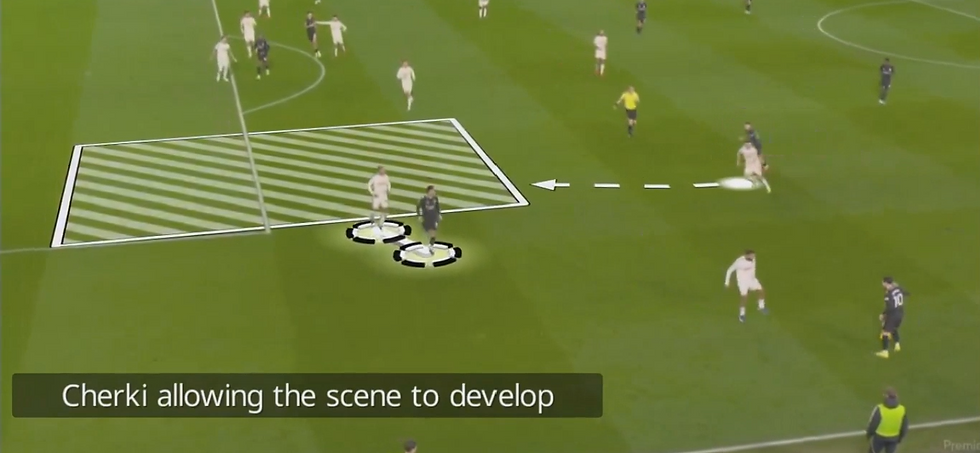
Cherki does well to hold onto the ball and wait for the situation to develop, while Aït-Nouri recognizes the opening and makes the off-ball run through the gate to arrive and provide the assist.

Domino Effect
Now, who said that only one player moving off the ball is enough to disrupt the opposition’s defensive structure? I didn’t. In fact, when two or more players are on the same wavelength, aware of their surroundings, and properly time their movements, one action can trigger the next and the opposition’s block begins to fall like dominos. The following sequence that led to Caicedo’s wonder strike against Liverpool is a perfect example of that.
Here, you can see Caicedo positioning himself on Szoboszlai’s blindside. At that moment, the direct pass towards him is blocked.
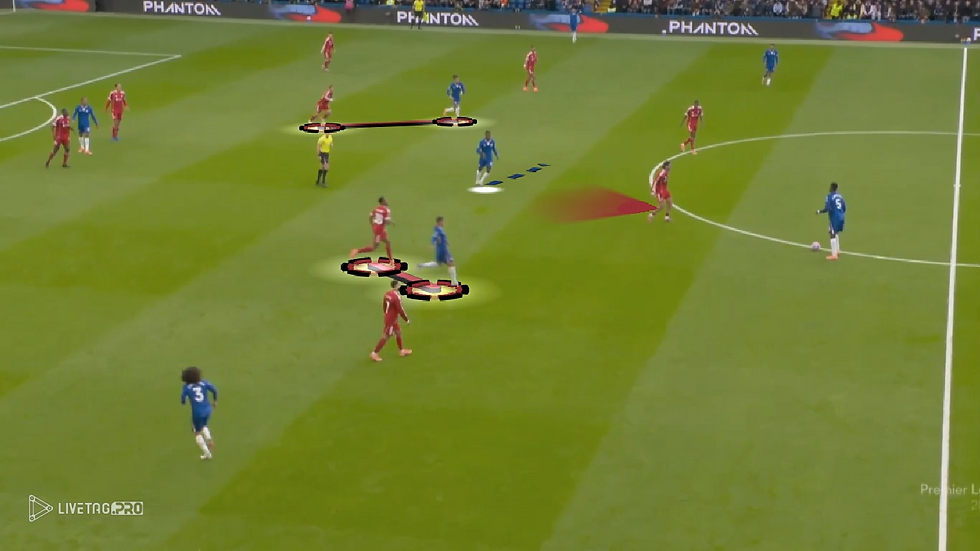
However, with Enzo Fernández and Malo Gusto timing their movements perfectly, they drag both Gravernberch and MacAllister forward, vacating the central space. From there, the bounce pass from Badiashile to Malo and onto the Ecuadorian was made.

Off-Ball Movement Is Your 12th Player
Like the Remi Himbert sequence analyzed earlier, particularly the first few steps he took, off-ball movement doesn’t always have to be a sudden change of direction or an explosive run in behind. Sometimes, minimal but constant adjustments can influence the opponent and allow the player to provide a consistent option through an opposition block, drag defenders around to create space for others, or even arrive in a goalscoring position.
In the following sequence, Riccardo Calafiori (surprising choice, right?) becomes Arsenal’s 12th player.
For more than a minute (Gif below is fast-forwarded), Calafiori’s continuous movement; dropping deep, stepping back up, pausing, and taking small backward steps, allowed him to constantly offer a passing option to his teammates while subtly manipulating Fulham’s players.

His positioning dragged opponents out of their position and ultimately pinned Fulham’s left-back inside creating the conditions for Trossard to receive the long switch. All of that work got Calafiori in a dangerous position to score the goal, which was unfortunately disallowed.

The Duel Before the Duel:
In a game increasingly dominated by man-to-man schemes, the battle often starts before the ball even arrives. Defenders track, follow, and try to eliminate every passing option. But movement can change everything.
A well-timed step across a defender’s front shoulder. A subtle curved run toward the blindside. A simple jog toward the ball side that drags an opponent away. One movement can manipulate a marker. Two movements can destabilize a line. Three coordinated actions can collapse an entire defensive block. That is why off-ball movement can feel like having a 12th player on the pitch.
Because while the opposition thinks they are defending 11 attackers, the real threat is the constant manipulation happening away from the ball. Players are being dragged out of position, passing lanes are opening, and defensive references are slowly disappearing.
That is why winning the duel before the duel is now more crucial than ever. Gain the slightest advantage without the ball to create better conditions once you receive it.


Comments