
The High Press Explained: Risk vs Reward
- Mik Van Well
- Mar 24
- 9 min read

The analytical revolution in football over the past decade caused a shift in build-up strategies. Previously, short build-ups were mostly associated with top-level technical teams, like Pep Guardiola’s Barcelona. Teams that were patient in possession were classified as dominant and teams who lost despite having more possession were unlucky. However, since expected goals and other advanced metrics have worked their way into football boardrooms and onto tactical boards, the rewards of short build-ups were embraced by the rich and the poor. Even managers of relegation-threatened sides believed that controlled possession provided a higher probability of creating chances than playing long and relying on second balls.
A study by Opta Analyst after the first five game weeks in the 24/25 Premier League season revealed the results of this tactical shift: recently promoted Southampton ranked tied last with 1 point after five games, but ranked tied first in terms of goal kicks taken short (88%). Arsenal, undefeated at that point, comfortably ranked last in proportion of short goal kicks, with just 15%.
This increase in short build-ups, however, ignited another tactical shift. Teams with lower technical ability—24/25 Southampton simply can’t compete with 08/09 Barcelona—are now reluctant to play long balls and willing to play short no matter what. This incentivizes a defensive strategy used to disrupt build-ups: high pressing. High pressing teams seek to regain possession as quickly and as high up the pitch as possible. The core idea is simple: the closer the ball is won to the opponent’s goal, the shorter the distance to create a scoring opportunity.
The graph below highlights the increased incentive of high pressing: teams are scoring almost twice as many goals from high turnovers as a decade ago.

This analysis will use last week’s Champions League games as a case study to examine how teams exploit the reward of high pressing, as well as the risk associated with pushing your defenders forward.
Triggers
Pressing is physically intense and difficult to do continuously. Therefore, most teams will only initiate their high pressing structures during specific game situations or after specific triggers. Those triggers are typically:
- Dead-ball situations: goal kicks, throw-ins, and free kicks within the defensive third
- Errors: inaccurate passes or poor first touches
- Passes to specific players: mostly back passes towards the goalkeeper
- Counterpressing: immediately after losing the ball
Waiting on these specific triggers reduces chaos and makes pressing easier to train and explain for coaches.
High pressing structures
Pressing with +1
The most traditional and still common pressing structure for many teams is pressing with a numerical advantage within the defensive line: +1 at the back.
Keeping a spare defender within the defensive line means pressing at a numerical disadvantage up front. Traditionally, this meant a lone striker was responsible for two centre backs. However, this pressing structure is easily beaten by third-man combinations. Besides, if the opposing team is patient enough, the striker will eventually run out of energy to continue pressing alone at high intensity.

Alternatively, teams would apply a pendulum press, using two forwards or a striker and an attacking midfielder. The two players would, in turns, press the centre back on their side, or track back towards the deepest midfielder. This set-up limits the occurrence of unmarked centre backs and shares the pressing burden between two players.
However, over the course of a full match, pressing two centre backs and a midfielder with two players remained inefficient. The emergence of ball-playing goalkeepers—with Manuel Neuer as pioneer—increased those inefficiencies, as the numerical disadvantage became even bigger.
Modern +1 Pressing
To increase the efficiency of pressing at a numerical disadvantage, modern coaches have started to use a powerful weapon: the sideline. Teams now focus on closing central channels, forcing opponents to build up through wide areas. To prevent teams with two centre backs from building up following deep build-up situations—mostly goal kicks—pressing with a front two has become a common structure. FIFA’s graphic below highlights this development, comparing the 2022 World Cup with last year’s Club World Cup.

During goal kicks, defending teams often line up with two players within the centre at the edge of the box, applying immediate pressure after the goal kick is taken. In the past, the goalkeeper would always take goal kicks, allowing pressing teams to immediately force the receiving centre back towards one side of the pitch. By making a curved run, a back pass to the goalkeeper is prevented and, thus, the numerical disadvantage neutralized.
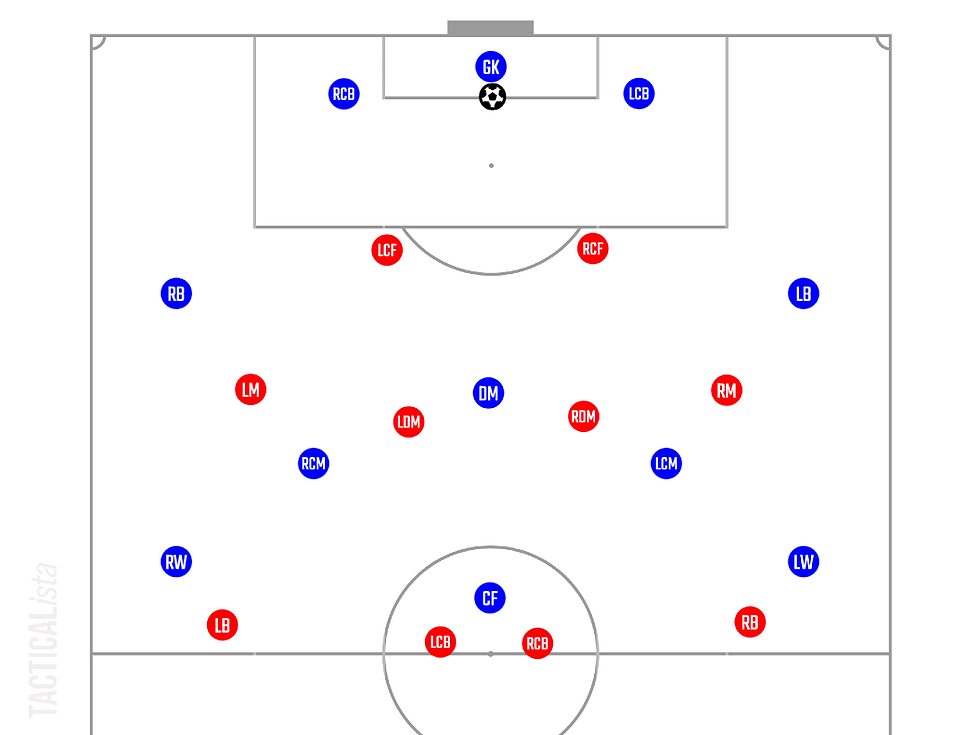
Nowadays, many teams will let one of the centre backs take the goal kick, playing it back to the goalkeeper. This creates a symmetrical distribution of players and the ball, neutralizing any advantage for the defensive team to initiate a press by eliminating the goalkeeper immediately.
Although teams in possession try their best to limit opportunities for high pressing, eventually, triggers will occur and defensive teams can apply their +1 pressing structures, like Tottenham Hotspur against Atletico Madrid last week, using a 3-4-3 formation.
When Atletico moved the ball towards one side of the pitch during low build-up, Spurs’ winger on the ball-side would join the striker, pressing the opponent’s centre backs. The wingback on the ball-side then advanced towards the full back, creating a man-to-man press around the ball.
On the weak side (side without the ball), the wingbacks tuck inside to create a numerical advantage within the defensive line.

This leaves the winger on the weak side in a 1v2 situation. However, teams trust their pressing structure enough to leave the opponents in large spaces on the weak side. If the offensive team is able to play through or around the press and switch play to the other side, the spare defender can be used as an emergency back-up, to mark one of the players in the 1v2.
Spurs players (goalkeeper Kinsky most notably) made some big individual mistakes against Atletico, but their pressing structure wasn’t necessarily bad. After ten minutes, Spurs attempted their first shot of the match, generated through this exact pressing structure.

Atletico’s Julián Alvarez was forced to play a difficult first-touch pass under pressure, which was intercepted by Spurs and led to a chance for Mathys Tel.

Tel’s shot had a low scoring probability (0.03 xG), but Spurs’ high pressing led to a more dangerous shot and their second goal of the night during the second half.
A backpass to Atletico’s goalkeeper triggered a curved run by substitute striker Solanke, neutralizing the right centre back and forcing the goalkeeper to the left.

Again, Spurs’ left winger is on the weak side in a 1v2, but Solanke’s run prevents a pass towards the weak side.

As Spurs are man-marking every opponent on the ball-side, goalkeeper Oblak is forced into a turnover and Spurs can easily progress towards goal.


Leading up to Atletico’s second goal of the night however, the risk of high pressing became apparent. Although this goal was also characterized by individual mistakes, it was also a product of losing the numerical advantage at the back.
Midfielder Sarr lost his direct opponent for just a moment, and was trailing him towards goal. However, Spurs’ defenders hadn’t shifted across enough and were unable to properly provide cover for Sarr.

Spurs were caught in a phase between +1 pressing and man-to-man pressing, which led to a quick 2-0 deficit.
PSG applied a similar pressing structure as Spurs against Chelsea. After a pressing trigger, centre forward Dembélé forced Chelsea’s build-up towards one side. In the example below, they kept a defensive midfielder as a spare player, within their back line. This meant left winger Barcola was temporarily defending two opponents, but Chelsea were unable to switch play, turning the ball over under pressure.

Chelsea eventually found a solution to PSG’s pressing structure—or at least a way of removing the numerical advantage at the back.
Right back Malo Gusto moved into an extremely advanced position.

When PSG forced Chelsea towards their left flank, the large distance between Chelsea’s right centre back and right back was too large for Barcola to mark them both.

This forced PSG to commit to a man-to-man press, without a +1 at the back. Chelsea utilised this solution to exploit the pace mismatch between Pedro Neto and Marquinhos. With a third-man combination, the Portuguese winger was launched towards Chelsea’s goal.

This same mismatch eventually led to Chelsea’s second goal of the night. However, PSG also reaped the rewards of high pressing, forcing Chelsea’s goalkeeper into a turnover ahead of Vitinha’s goal, which put them ahead.
Man-to-man pressing
Atletico Madrid take a different pressing approach. Embracing the risk of pressing without a +1, but reducing the risk of getting caught in between, they use triggers to commit to a man-to-man press across the entire pitch.
When Spurs had a goal kick for example, Atletico's left midfielder and left back pushed forward, mirroring Spurs’ 3-4-3 formation.

The 1v1 duels all over the pitch left Spurs with only one option: a long ball. When their goalkeeper takes that long ball, Atletico's players (highlighted below) immediately move back into a more secure low block.

In the example above, the Spurs goalkeeper slips and Atletico score their first goal of the night, but forcing a long ball was the initial target.
Another pressing trigger discussed earlier is a back pass. In minute 15, Spurs were forced to play a back pass to their goalkeeper, which triggered the same man-to-man pressing structure as during goal kicks.

Atletico’s left midfielder and left back pushed forward aggressively.

Again, Spurs’ goalkeeper fumbles under pressure and Alvarez is able to score on an open goal.

Atalanta also applies man-to-man pressing, but to a more extreme extent. Atletico’s structure remained relatively intact against Spurs, but Bayern head coach Kompany found some smart solutions to disrupt Atalanta’s press.
Atalanta’s players are instructed to follow their direct opponent all over the pitch. Bayern embraced this mechanism by rotating players all over the pitch. This created chaotic situations, like the one below.

Atalanta’s right midfielder, a dynamic wide forward, was now man-marking within the defensive line. Defensive midfielder De Roon was defending as a winger and full back Zappacosta was defending the centre of the pitch.
During a slight moment of doubt whether the latter should stay central, he lost sight of his direct opponent.

Luis Díaz utilised this opportunity and was able to receive the ball and turn forward.

We then see the risk of wide midfielders defending in a lower position. Nicola Zalewski failed to track the run of Bayern’s right back and Atalanta were suddenly defending in a 2v3 situation, which led to a dangerous shot by Olise.


Fifteen minutes later, Bayern’s rotations led to danger again. Both of their defensive midfielders dropped into their defensive line, forcing Atalanta’s double pivot to follow them.

In the space behind their central midfielder, one of Atalanta’s forwards failed to track Bayern’s centre back Upamecano, who was able to pick up the second ball.

Upamecano was able to continue his run towards Atalanta’s box and delivered an assist to Olise.

A few minutes later, Atalanta’s left centre back, Kolasinac, was dragged out of position by Bayern’s Gnabry.

After another long ball, Kolasinac failed to track Gnabry’s forward run and the remaining defenders were outnumbered.

Gnabry received the ball and continued his run into the box, scoring Bayern’s third goal in 25 minutes—two of which were created from a high press by Atalanta.

Zonal pressing
The final pressing structure, zonal pressing, was applied by Manchester City in their 3-0 loss against Real Madrid. Guardiola instructed his players to stay within their 4-1-3-2 formation, defending specific zones during high pressing, rather than specific players.
Real Madrid was able to spark some doubt into the City players’ heads, by playing with a false nine. Brahim Díaz started as their striker, but usually dropped deep, as fourth midfielder. Below, Real has a goal kick and Díaz does exactly that. Guehi (left centre back, highlighted) is communicating with Guardiola, asking whether he should stay within his zone or step up towards Díaz.

Eventually, Guehi decided to step out of his zone, leaving a large gap between Man City’s left back and right centre back—who stayed within his zone.

Real’s goalkeeper Courtois recognized the gap and played a long ball towards Valverde, who had a head start of a few meters against full back O’Reilly.

Valverde passed goalkeeper Donnarumma and scored Real’s first goal of the night.

Later during the first half, Guehi thought he had learned from his mistake, and stayed within his zone, allowing Díaz to freely roam around the pitch.

Defensive midfielder Rodri was lured towards Real’s right flank. Courtois then quickly switched play towards their left flank.
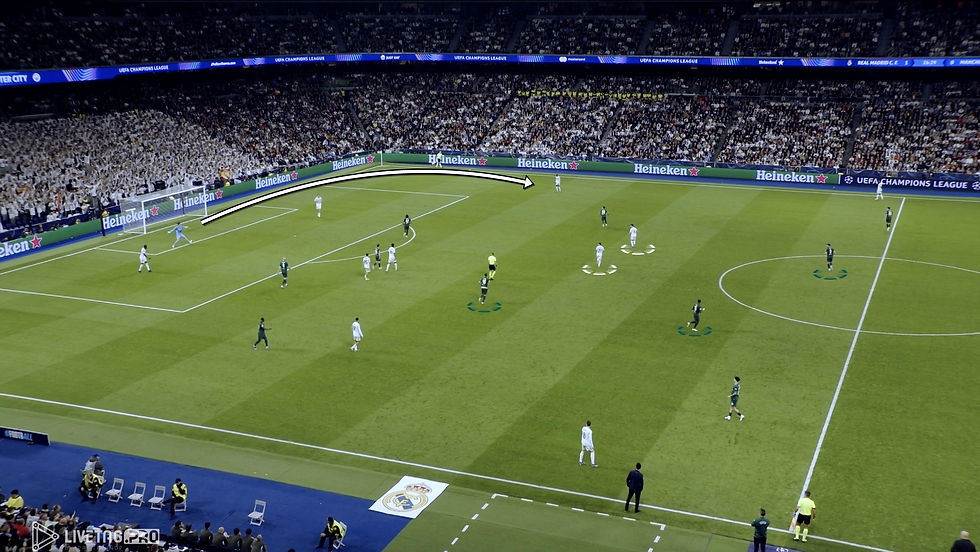
Díaz has moved towards the left half-space and is now unmarked, together with attacking midfielder Güler, as Rodri is chasing them.

The two creative midfielders are able to combine within the left half-space and launch a counter attack. Rodri and Man City’s central defenders are all defending their zones, which are still unoccupied by opponents.

Federico Valverde eventually converts this counter attack, exposing Man City’s high press for a second time, despite a different defensive approach.
Conclusion
High pressing is not simply an aggressive defensive tool, but a calculated trade-off between control and vulnerability. As teams increasingly prioritize short build-up to maximize chance creation, they simultaneously expose themselves to pressure higher up the pitch. This has made high pressing one of the most effective ways to generate attacking opportunities through defensive actions.
However, as the Champions League examples illustrate, there is no single correct way to press. Whether using a +1 structure, committing to man-to-man duels, or maintaining zonal discipline, each approach offers distinct advantages while carrying inherent risks. The key determinant is not just the structure itself, but the clarity of execution—teams that hesitate or lose organization are often punished immediately.
Ultimately, high pressing amplifies both ends of the game: it increases the likelihood of creating chances close to goal, but also heightens the risk of conceding when the press is broken. This balance between reward and risk explains both its growing popularity and its decisive impact at the highest level.
The animation below shows an accelerated version of a 90-second period during PSG - Chelsea of uninterrupted high pressing. This underlines that high pressing has become a defining trend in modern football.


Comments