
WHY DE ZERBI MAKES SENSE FOR MAN CITY POST-GUARDIOLA
- Matt Smith
- Jan 29
- 6 min read

Manchester City could be in the market for a new manager at the end of the season, and it’s set to be one of the toughest decisions the hierarchy will have to make since their arrival. Pep Guardiola has brought so much success to the Etihad Stadium, completely transforming how City play, and it’s imperative that they find the right replacement.
To ensure a smooth transition, finding a coach who will bring in a style that isn’t a complete shift in the opposite direction would be beneficial.
That man, is Roberto De Zerbi.
When De Zerbi arrived at Marseille, he introduced an aggressive possession game, built on structured build-up play, positional rotation, and intense pressing. His build-up style differs from Guardiola’s slightly, but the same principles remain, such as building from the back and trying to get his best attacking players in the most optimal positions.
In Possession

In deep build-up, De Zerbi has his wing-backs placed in advanced positions, pinning the opposition defenders back into a defensive block. This allows space for his central midfielders to come into wide areas, usually to receive the ball in space.

De Zerbi’s in possession principles are built on finding the free man. Having seven players deep in your own half will more than often mean you will have a +1 in the build-up, and this is where they remain patient, waiting to find that spare player.

Using the goalkeeper in the build-up is another way De Zerbi is trying to find the free man. This allows his side to create a back-four, meaning they have extra options to overload central areas, with the centre-backs coming wide to become options on the ball. As you can see above, four players are free men in the central areas.

Marseille look to remain patient in their build-up, passing between the centre-backs and number six, waiting to release the free man. In the case above, they keep the ball at the back before shifting to the wide centre-back, inviting pressure from the two midfielders, creating a huge gap between the opposition midfield and defence.

This allows the centre-back to carry out of defence, and due to Marseille having plenty of free men in the middle, the opposition defender is forced to jump, leaving space behind the defence to exploit.
De Zerbi certainly isn’t against his sides going long when they have to, but that space has to be created in order for them to do so.

The numerical advantages always allow Marseille to find a central player in space, taking multiple players out of the game and beating the press.

The Marseille centre-back can then play a one-two, knowing they still have a comfortable rest defence, while this is a trigger for Marseille’s wing-backs to get in behind, exploiting the space to receive the ball.
Marseille’s wing-backs aren’t your traditional wing-backs. The likes of Igor Paixao and Timothy Weah are often utilised in these positions, players who are naturally wingers, which could suit some of Man City’s current stars.
Against man-to-man pressing systems, Marseille will look to use movement all over the pitch in order to keep finding that freeman. One of the three centre-backs has the freedom to come into a right-back area to receive a pass, while they also trust their midfielders, despite being closely marked, to quickly bounce a pass into a freeman.
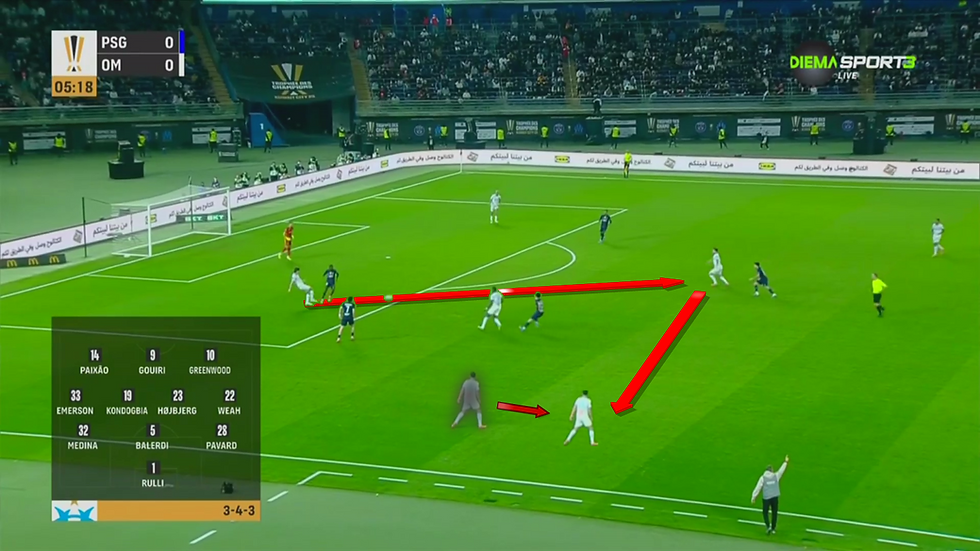
This is another method of attack, with one of the forward players dropping off the attacking line to come in to receive, as seen below. Small movements all over the pitch allow Marseille to find that free man, usually a dangerous player, in acres of space.

Looking at their build-up, this should transfer to Man City with ease. The likes of Josko Gvardiol and Marc Guehi are comfortable on the ball to play progressively in build-up. Phil Foden could be utilised in one of the central midfielder roles, with the system hopefully getting him on the ball in space more regularly. Rodri knows how to play the number six role with his eyes closed. There shouldn’t be too much of an adaptation period.
Phil Foden’s Dream Manager
The way De Zerbi’s side build up in possession, they are always looking to bypass the opposition press before finding a free man. Marseille remain patient with the ball, and the movement of their attacking players allows them to skip the midfield before creating space for others.

In the above video, you’ll see a striker dropping deep in order to receive, helping Marseille bypass a host of opposition players. A simple pass back, then allows the defensive midfielder to move the ball to the other side of the pitch, where Ethan Nwaneri is in space.
The role of Nwaneri in this system is absolutely tailor-made for Phil Foden. He has freedom to get on the ball in deeper positions, the setup allows him to become a free man regularly, and he can drive from deep before getting into advanced areas.
It’s a similar case for Rayan Cherki, and getting the likes of him and Foden in space is a recipe for success.
Out of Possession

In terms of De Zerbi’s out-of-possession structure, he always likes his sides to go man-to-man all over the pitch. This makes it difficult for opposition teams to play out. When the opposition completes a pass, this is when the trigger is to intensify the press, giving players minimal time on the ball to make things happen.
Marseille are happy for the opposition to funnel the ball out wide before triggering the intense press, doing everything to prevent teams playing through the middle, with a centre-back usually stepping out of the defensive line to help with this.
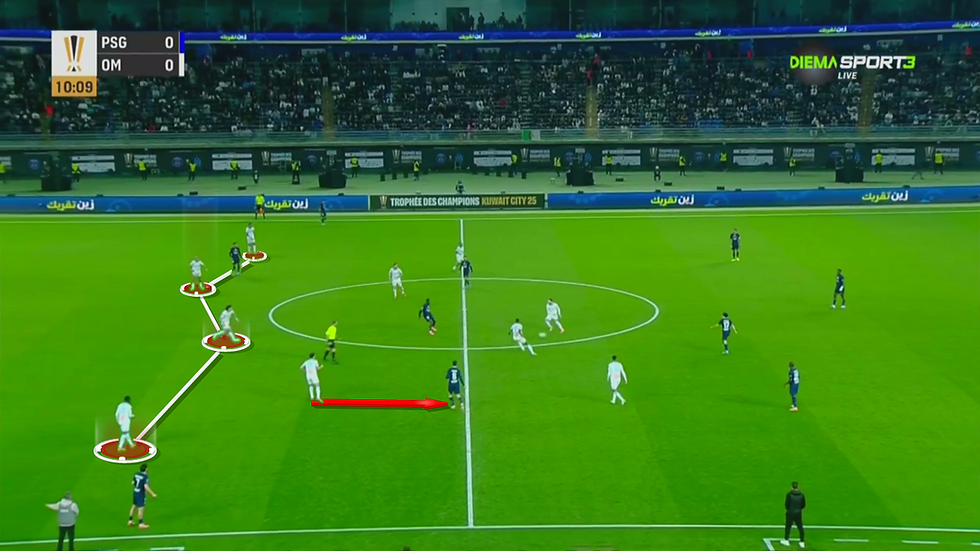
Although a back three/five on paper, Marseille are usually in a defensive four structure, due to one defender allowed to come out of the block in order to press a midfielder.

To always ensure a back-four structure, this is interchangeable. If one centre-back presses, another drops, and vice versa when the ball is moved.

This almost creates a 4-2-3-1 structure out of possession with one of the centre-backs making a two in midfield, with the remaining four made up of the other midfielders and attackers De Zerbi’s system is very fluid, meaning it doesn’t matter who is in these positions at any one time, as long they keep that structure.
Would this suit Manchester City? I don’t believe they currently press as intensely as a De Zerbi side, so that would be one shift that they would be forced to get used to. Defenders stepping into midfield is a normality for City players. Although they usually come into midfield in possession, rather than out, they’ll be comfortable in these areas if they win back possession, meaning they can turn defence into attack with ease.
How could Man City setup under De Zerbi?
Man City’s current crop of players should fit quite well into De Zerbi’s current setup.

On paper, this is the kind of setup we might see in possession, and there’s no doubt they have the players capable of doing it.
Goalkeeper
Gianluigi Donnarumma isn’t the best goalkeeper in the world with his feet, and that might be a small concern for De Zerbi, but he’s played in possession-based sides for most of his career, so he should have no problem stepping into the defensive structure to create a back four.
Centre-backs
Marc Guehi and Josko Gvardiol are capable wide centre-backs, with the former regularly playing in a back three and the latter spending a lot of his time at City as a left-back. The central centre-back position is up for grabs, with City having a host of options for this position.
Midfield
As mentioned, Foden is the ideal man for that right-sided eight position in build-up, while Rodri will likely be the sole six. Tijani Reijnders could be one of the options for the left-hand side, where De Zerbi prefers more of a natural central midfielder, more capable on the defensive side of things.
Forward players
This is an interesting one. De Zerbi likes his wingers to stay incredibly high and wide in possession, pinning defenders back. This is great news for Doku and Semenyo, who will often be tasked with getting in behind, or getting into 1v1 situations with defenders. They will be forced to drop into a back five at times, so that would be a slight change for the aforementioned two.
Rayan Cherki could be given a bit of a free role, dropping into midfield areas but also playing on the last line with Erling Haaland. Cherki is also capable of playing in one of the deeper midfield roles.
In Conclusion
City currently have a crop of players that would suit De Zerbi, and his possession-based, high-intensity system could translate well. De Zerbi feels like the natural solution for City if Guardiola does head through the exit door.


Comments